

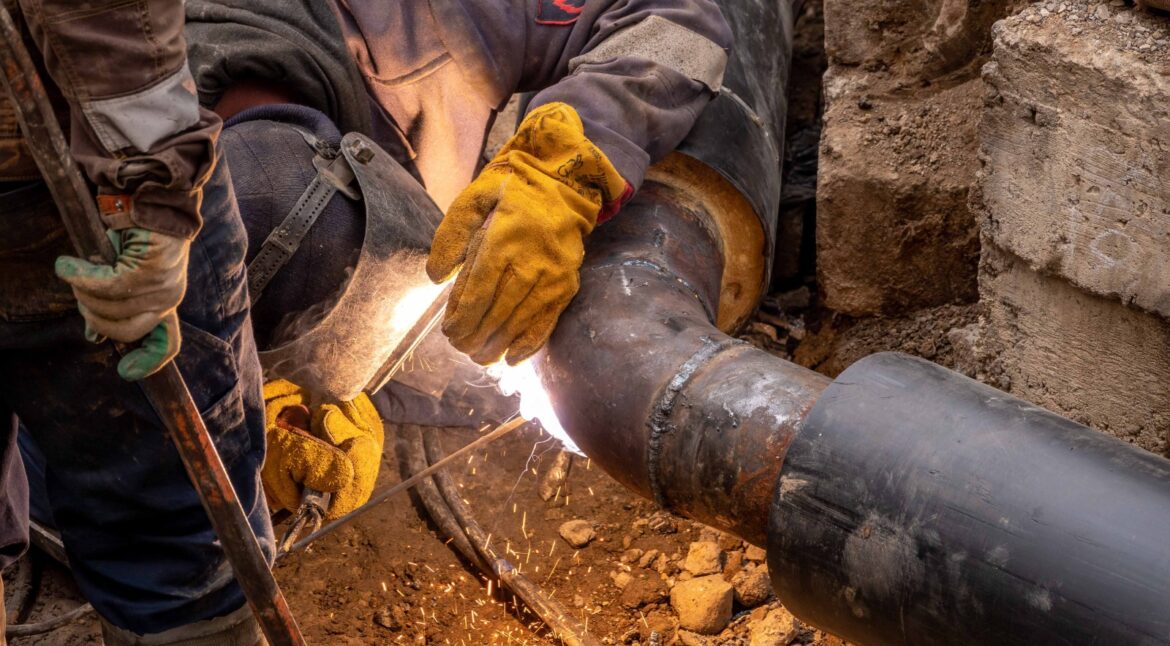
A distributor may receive two stainless pipe offers that match on grade, nominal size, and schedule but differ in one important line item: one is seamless and the other is welded. That difference should not be treated as a minor purchasing detail. The manufacturing route can be part of the customer’s specification, code basis, qualification, or approved-material requirement.
TubeSales is focused on stainless seamless pipe supply for distributors. That focus is useful when a customer RFQ specifically calls for seamless material and the distributor needs an additional supply source without going directly to the end user.
What Is the Basic Difference?
At a high level, seamless pipe is produced without a longitudinal welded seam. Welded stainless pipe is formed and joined by a welding process. The important point for procurement is not to turn that manufacturing difference into a universal “better versus worse” rule. Both seamless and welded austenitic stainless steel pipe can be manufactured to recognized specifications when the applicable requirements are met.
ASTM A312/A312M, for example, covers seamless, straight-seam welded, and heavily cold-worked welded austenitic stainless steel pipe for high-temperature and general corrosive service. The specification also includes testing, heat-treatment, dimensional, and mechanical-property requirements.
Why the RFQ Wording Matters
If a customer has specified seamless pipe, a welded alternative should not be offered as an automatic dimensional substitute simply because the NPS, schedule, and grade match. The project may have engineering, owner, code, testing, historical, or approved-vendor requirements behind the seamless callout. The same principle works in reverse: a buyer should not assume that a different manufacturing route will be accepted without review.
What Distributors Should Capture
Before requesting supply, capture the exact product description from the customer: grade, NPS, schedule, seamless/welded requirement, ASTM or other specification, quantity, lengths, documentation requirements, and required delivery date. If the customer allows alternatives, identify that explicitly so the supply partner knows there is room to propose another option.
Avoid the “Same Size = Same Material” Trap
Dimensional equivalence is only one part of material compliance. A pipe can match the requested OD and wall thickness and still fail to match the required manufacturing route or specification. For distributors, preserving those details protects the quote, reduces rework, and helps avoid offering material the end customer cannot accept.
If your customer requires stainless seamless pipe, send TubeSales the complete line item and required date. We support distributors with 304/304L and 316/316L seamless pipe inquiries and inventory-gap requirements across North America.

